Table of Contents
Direct Booking Website for Small Hotels: Cut OTA Commissions
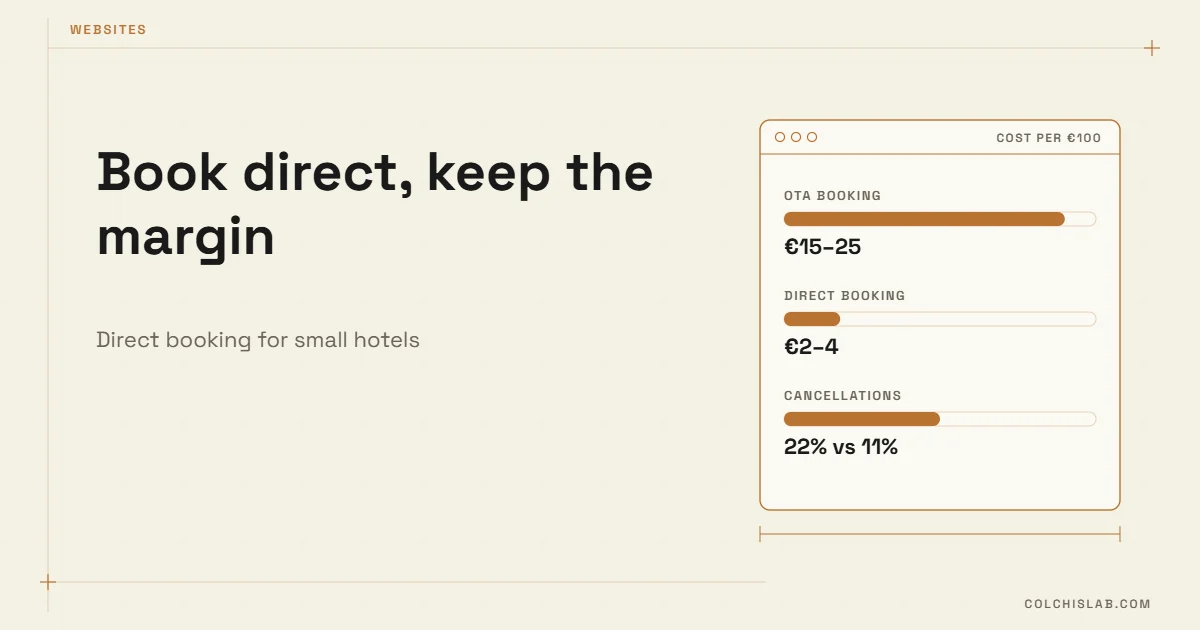
A direct booking website for small hotels is a hotel site with a built-in booking engine, live availability and a clear reason to book there instead of on Booking.com or Expedia. It will not replace OTAs, and it should not try to. The realistic goal is to move 10–20% of your bookings to direct, which for a 20-room property is often worth €5,000–10,000 a year after costs.
Below: what OTAs really cost in 2026, the features that make guests book direct, how to appear on Google Hotels for free, what Europe’s parity rules now allow, and a worked example you can adapt to your own numbers.
Table of Contents
What OTAs Really Cost a Small Hotel
Booking.com states that its global average commission is 15%, varying by country and property type. That is only the base. Visibility programmes such as Preferred Partner typically add a few percentage points, Genius discounts come out of your rate, and payment handling adds more. Many small hotels end up paying 18–22% on an OTA booking all-in.
- Booking.com: 15% average base, plus programme and payment extras.
- Expedia: usually 15–25%, depending on your contract and visibility options.
- Airbnb: most hosts moved to a single host-only fee of about 15.5% in late 2025.
- Direct booking: booking engine and card fees, typically 2–4% of the booking value.
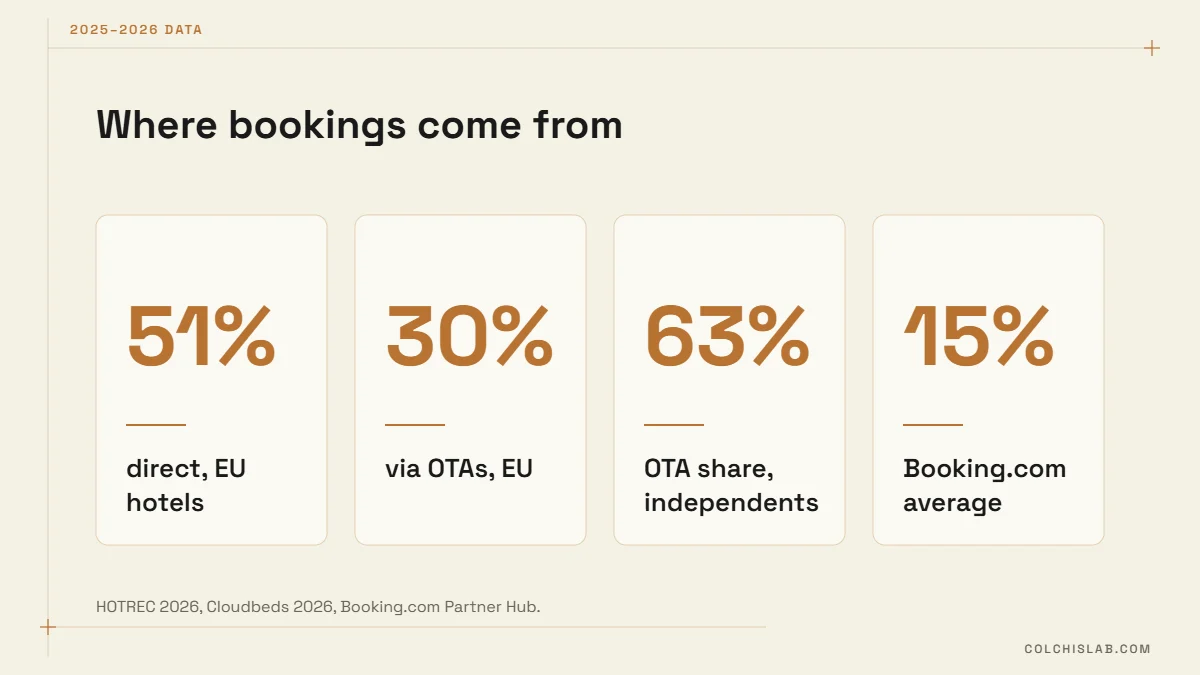
Channel mix is the other half of the case for a direct booking website for small hotels. The Cloudbeds 2026 hotels report (90 million bookings) found that OTAs delivered 63.4% of bookings for independent properties – and OTA bookings were cancelled at roughly twice the rate of direct ones (21.8% vs 10.6%). In Europe, HOTREC’s 2026 distribution study puts direct bookings at about 51% and OTAs at about 30%, with Booking.com alone holding two-thirds of the OTA share.
A worked example
Take a 20-room hotel with a €95 average rate and 70% occupancy: about 5,110 room nights and €485,000 of room revenue a year. If 60% arrives through OTAs at an all-in 18%, commission is roughly €52,000. Here is what moving 10 percentage points to direct does:
| Today | After +10 pts direct | |
|---|---|---|
| OTA share of revenue | 60% (€291,300) | 50% (€242,700) |
| OTA commission at 18% | €52,400 | €43,700 |
| Direct booking costs (3%) | €5,800 | €7,300 |
| Total distribution cost | €58,200 | €51,000 |
| Saved per year | – | ≈ €7,200 |
The saving funds the website many times over – and that is before counting lower cancellations and the guest data you keep. This is the business case for a direct booking website for small hotels: not “leave the OTAs”, but stop paying commission on guests who would have booked you anyway.
10 Must-Haves of a Direct Booking Website for Small Hotels
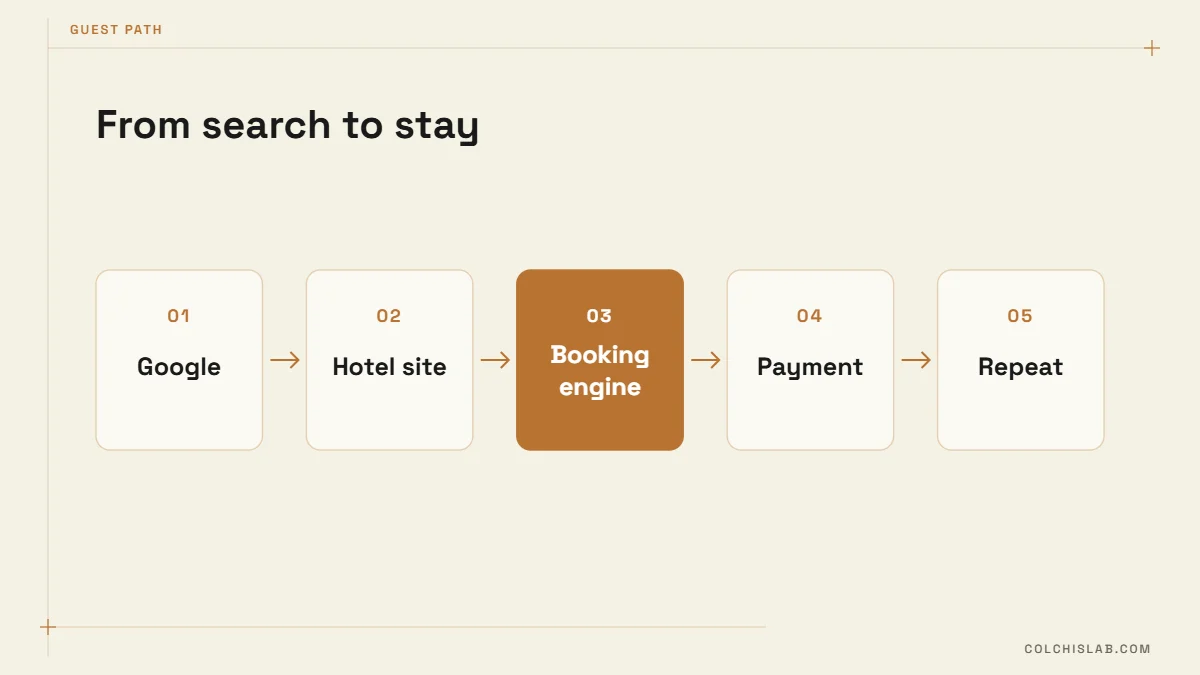
Most small hotel sites fail at the same point – and a direct booking website for small hotels lives or dies on it: the booking step. A beautiful homepage that sends guests to a slow, foreign-looking booking page loses them back to the OTA tab they still have open. These are the features we build into every hotel project:
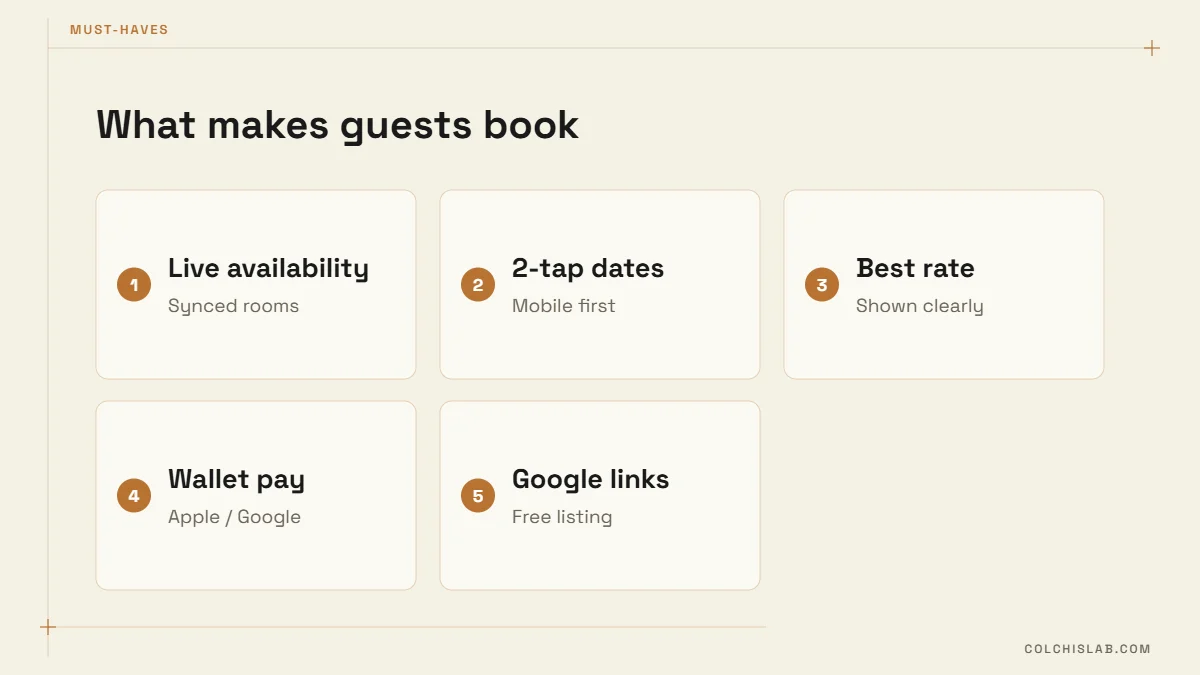
- Live availability and rates synced with your PMS or channel manager, so the site never sells a room that is gone.
- A booking widget on every page, with a two-tap date picker that works one-handed on a phone.
- The booking engine inside your design (same domain, fonts and colours), not a jump to a generic page.
- A visible best-rate message – and a real reason: a lower price, free breakfast, late checkout or flexible cancellation.
- Wallet payments (Apple Pay, Google Pay) alongside cards, and clear deposit and cancellation terms.
- Room pages that answer questions: size in m², bed types, real photos, view, accessibility and what is included.
- Languages and currencies for your main source markets.
- Speed: under 2.5 seconds to largest content on mobile; hotel sites are often overloaded with photo sliders.
- Trust signals: recent reviews, address and map, phone and WhatsApp, secure payment badges.
- Hotel schema markup and a complete Google Business Profile, so search engines understand rooms, prices and location.
Speed and structure are where most redesigns pay off; our website redesign checklist and PageSpeed case study show how we test both.
Get Free Google Hotels Booking Links
Since 2021 Google has shown free booking links in hotel search and Maps. Google’s hotel partner programme lets a property appear there through its Business Profile or by having its booking engine or connectivity partner send live rates. The “Official site” badge is available only to the hotel or its own booking provider – never to an OTA – and only one partner per hotel can carry it.
For a direct booking website for small hotels, this is often the fastest win: guests comparing prices on Google see your own rate next to the OTAs, with no commission on free clicks. Ask your booking engine provider whether it is a Google Hotels integration partner before you sign. Pair it with a well-maintained profile – our Google Business Profile guide covers the details.
Rate Parity in 2026: What Europe Now Allows
For years, parity clauses stopped hotels from offering a lower price on their own site. In Europe that has changed. The EU designated Booking.com a gatekeeper under the Digital Markets Act in May 2024, and it dropped parity clauses for European hotels that summer. In September 2024 the EU Court of Justice ruled that neither wide nor narrow parity clauses are automatically justified. In 2026 more than 10,000 European hotels joined a collective damages claim against Booking.com in the Netherlands.
In practice: if you operate in the EU, you can publish a better direct rate. Outside the EU, read your OTA contract – narrow parity terms may still apply, and member-only or package rates are the usual workaround. This is not legal advice; check your own agreement.
Turn OTA Guests Into Direct Repeat Guests
OTAs are a good acquisition channel, and a direct booking website for small hotels should work with them. The mistake is paying them again for the same guest next year. A direct booking strategy should capture guests once they arrive:
- Collect email or WhatsApp consent at check-in or through Wi-Fi login, with a clear opt-in.
- Send a thank-you message with a returning-guest code valid only on your website.
- Offer a small member benefit (early check-in, a drink, free parking) for booking direct next time.
- Automate pre-arrival messages, upsells and review requests from your booking data.
We often connect the booking engine to a CRM and messaging so this runs on its own – see our booking chatbot and WhatsApp Business API chatbot guides.
Build Options and Costs
| Option | Typical cost | Best for |
|---|---|---|
| Website builder + hosted booking engine | Booking engine from about $39–179/month (e.g. Little Hotelier) plus booking fees | B&Bs and guest houses up to ~10 rooms |
| Custom website + all-in-one PMS/engine | PMS suites such as Cloudbeds are quote-based, often a few hundred dollars a month | 10–60 rooms that need a channel manager |
| Custom website + engine + CRM and automations | One-off build plus software subscriptions | Hotels with repeat guests, events or several properties |
Whatever version of a direct booking website for small hotels you choose, own the domain, the content and the guest data. Switching booking engines later should not mean rebuilding the whole site.
A Note for Hotels in Georgia
Georgia had 2,783 hotels and hotel-type properties in 2025, and about 63% of their 6.2 million guests came from abroad (Geostat). Most of those foreign guests discover small hotels on OTAs first – which makes a strong direct booking website for small hotels and a Google Hotels connection especially valuable. Local banks TBC and Bank of Georgia support card, Apple Pay and Google Pay checkout; our guide to accepting online payments in Georgia explains the setup.
Where to Start
Export last year’s bookings by channel, calculate what you paid in commission, and set a target share for direct. Then fix the booking step first, connect Google free booking links, and add a returning-guest offer. Our web development service builds hotel sites with integrated booking engines, and we are happy to look at your current site.
Planning a direct booking website for small hotels or a redesign? Send us your project with your room count, booking engine and main markets – we will estimate what direct bookings could save you.
How can a small hotel get more direct bookings?
Make booking on your site faster and better value than on OTAs: live availability, a mobile booking widget, a visible best-rate benefit, wallet payments, free Google Hotels booking links and a returning-guest offer for OTA guests.
How much commission do hotels pay to Booking.com?
Booking.com says its global average commission is 15%, varying by country and property type. Visibility programmes, Genius discounts and payment fees can push the effective cost to around 18–22%.
Can hotels offer lower prices on their own website?
In the EU, yes – Booking.com dropped parity clauses in 2024 under the Digital Markets Act, and the EU Court of Justice ruled against automatic justification of parity clauses. Elsewhere, check your OTA contract.
Are Google Hotels booking links free?
Yes. Free booking links have been available since 2021. You appear through your Business Profile or a booking engine or connectivity partner that sends your rates to Google.
How much does a hotel booking engine cost?
Simple hosted engines start around $39–179 a month plus small booking fees; all-in-one PMS suites are usually quote-based and cost a few hundred dollars a month, depending on rooms and features.
Should a small hotel stop using OTAs?
No. OTAs bring new guests and visibility, and a direct booking website for small hotels works best alongside them. The goal is to reduce dependence – shift a share of bookings to direct and convert OTA guests into direct repeat guests.