Table of Contents
AI Agents for Small Business: 10 Tasks They Handle Today
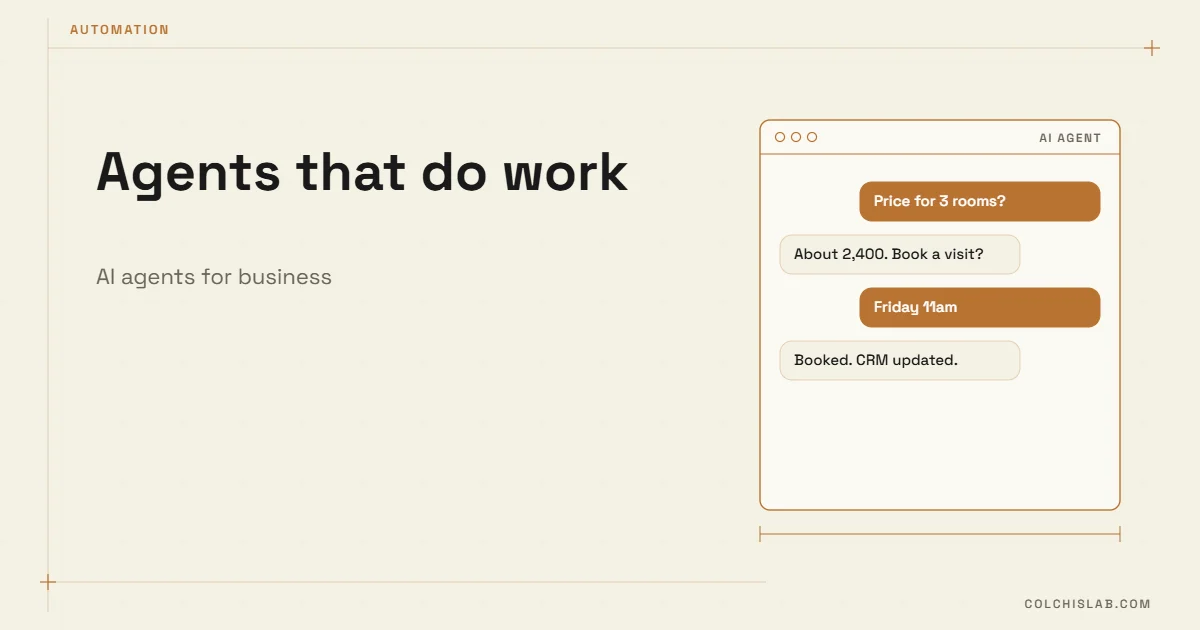
AI agents for small business are AI systems that take a goal — answer this customer, qualify this lead, book this visit — and complete it by reading data and using your tools, such as a CRM, calendar or inbox. Unlike a chatbot, an agent acts, not just replies. Today they reliably handle repetitive, well-defined tasks with clear rules, while a person keeps control of money, exceptions and anything irreversible.
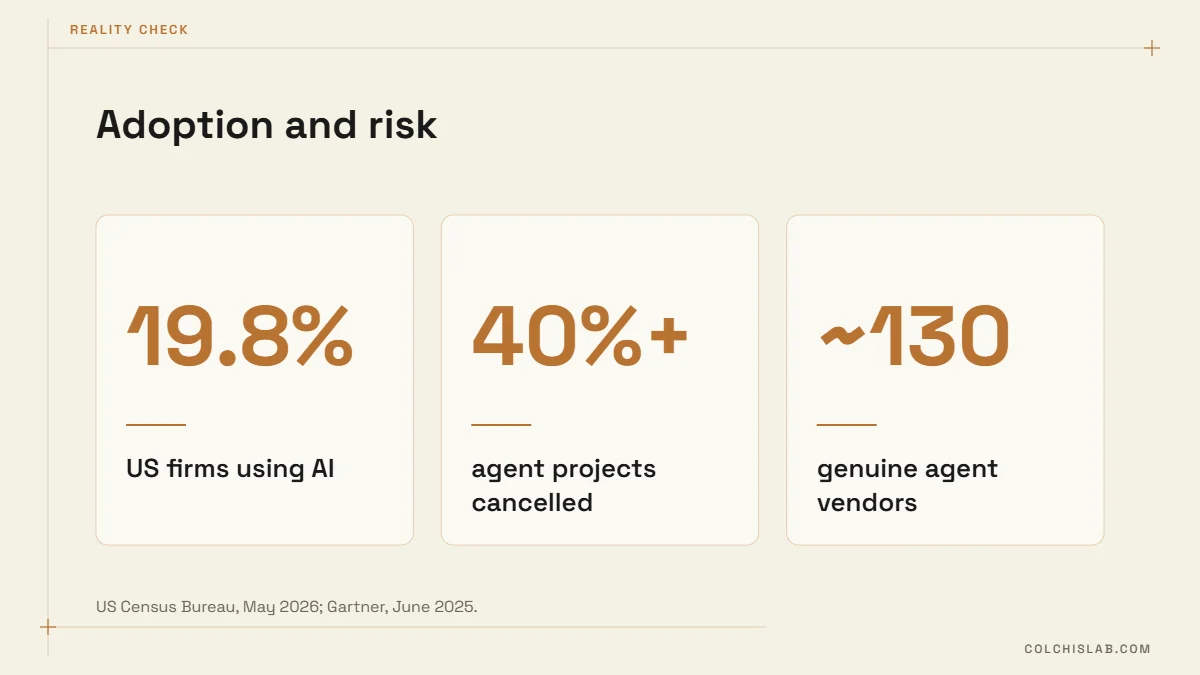
Adoption is still early: the US Census Bureau reported that 19.8% of US firms used AI as of May 2026, and fewer than one in five of the smallest firms. That leaves a real advantage for owners who deploy agents carefully. Below: clear definitions, ten tasks agents handle today, where they fail and what they cost.
Table of Contents
Agent vs Chatbot vs Automation
The three terms get mixed up — partly on purpose. Gartner warns about “agent washing” and estimates that only about 130 of the thousands of vendors marketing agentic AI offer genuine agents. Here is the practical difference:
| Classic automation | Chatbot | AI agent | |
|---|---|---|---|
| How it works | Fixed if-this-then-that rules | Answers questions in a chat | Plans steps toward a goal and uses tools |
| Handles messy input? | No | Partly | Yes, within limits |
| Takes actions? | Yes, predefined | Rarely | Yes: updates CRM, books, sends |
| Example | New form → add row to sheet | FAQ bot on a website | Reads a DM, qualifies, books, logs it |
In practice the best systems combine all three: deterministic automation (for example in n8n or Make) for the plumbing, and an AI agent only at the steps that need judgement. Our comparison of n8n vs Make vs Zapier covers the plumbing side.
10 Tasks AI Agents for Small Business Handle Today
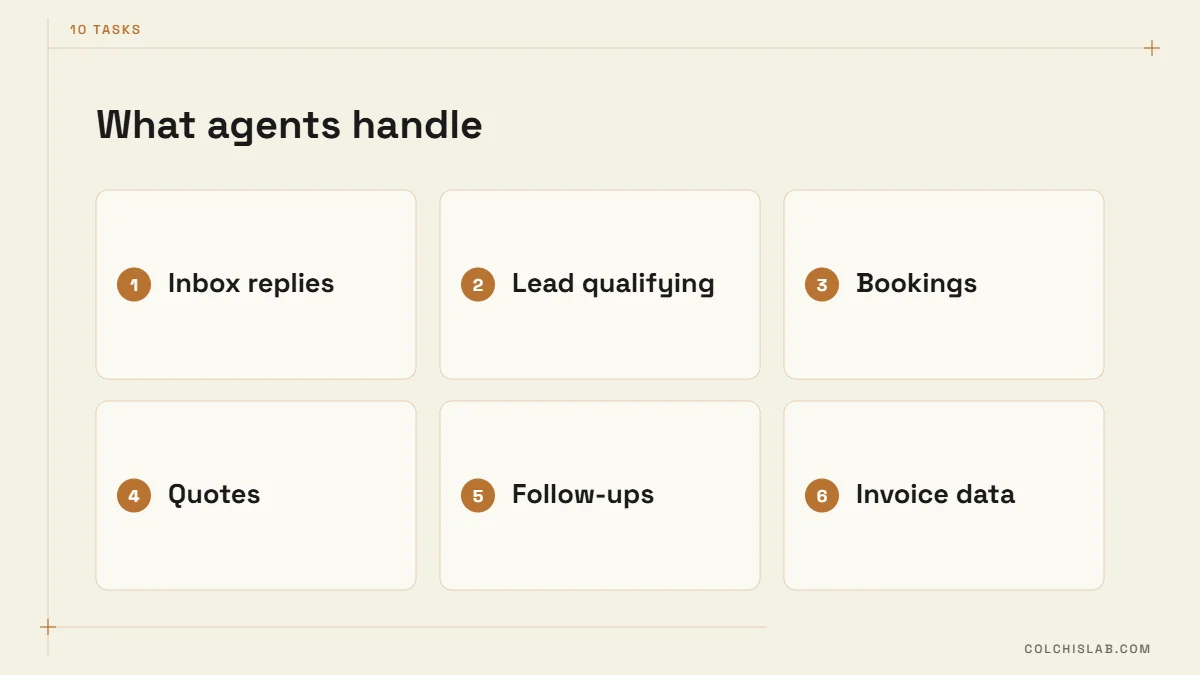
These are tasks we see working in production, not demos. Each has clear inputs, a limited set of actions and an easy way for a human to check the result.
- Answering inbox messages. Replies to Facebook, Instagram and WhatsApp questions about prices, hours and availability, using your own price list. Our Facebook page AI agent case shows a full setup.
- Qualifying leads. Asks budget, timing and location questions, scores the lead and creates a deal in the CRM — see automating lead qualification.
- Booking appointments. Checks the calendar, offers slots, confirms and sends reminders, as in our appointment booking chatbot.
- Preparing quotes. Collects dimensions or requirements and calculates an estimate from your pricing rules — the same logic as a calculator on your website.
- Following up. Sends a personalised follow-up when a quote goes unanswered for three days, and stops when the client replies.
- Summarising calls and meetings. Turns a recording or notes into a summary, next steps and CRM tasks.
- Extracting invoice and receipt data. Reads PDFs and photos, pulls supplier, date, amount and VAT, and prepares entries for your accountant to approve.
- Drafting review replies. Writes replies to Google reviews in your tone; a person approves negative ones.
- Prospect research. Builds lists of target companies and drafts personalised first emails for a person to review before sending.
- Answering internal questions. Searches your policies, product sheets and past orders so staff get answers without interrupting the owner.
Notice the pattern: every task ends in a draft, a record or a message that is cheap to correct. That is what makes AI agents for small business safe to start with.
Where AI Agents Fail
Gartner predicts that over 40% of agentic AI projects will be cancelled by the end of 2027, due to rising costs, unclear business value or weak risk controls (Gartner, June 2025). When AI agents for small business fail, we usually see the same causes:
- Vague goals. “Handle customer service” fails; “answer price and availability questions for 12 services” works.
- Missing or outdated data. An agent with last year’s price list confidently quotes wrong prices.
- Too much autonomy too early. Refunds, discounts and contract terms should never be the agent’s call at launch.
- Edge cases. Angry customers, complaints, legal or medical questions need an instant handover to a human.
- No measurement. Without tracking response time, conversions and errors, nobody knows if the agent helps.
A Readiness Checklist for AI Agents for Small Business
Before spending on a build, check five things. If you can tick at least four, AI agents for small business are likely to pay off for you; if not, fix the basics first, because an agent amplifies whatever process it sits on.
- Volume. The task happens at least dozens of times a week — fewer, and a person is cheaper.
- Written rules. Prices, policies and answers exist in a document, not only in the owner’s head.
- A system of record. Leads and customers live in a CRM or at least a structured sheet the agent can update.
- A clear owner. One person reviews the agent’s work and handles handovers.
- A metric. You know today’s response time, conversion rate or hours spent, so you can measure the change.
If the CRM part is missing, start there: our guide on what a CRM is explains the basics.
Keeping a Human in the Loop
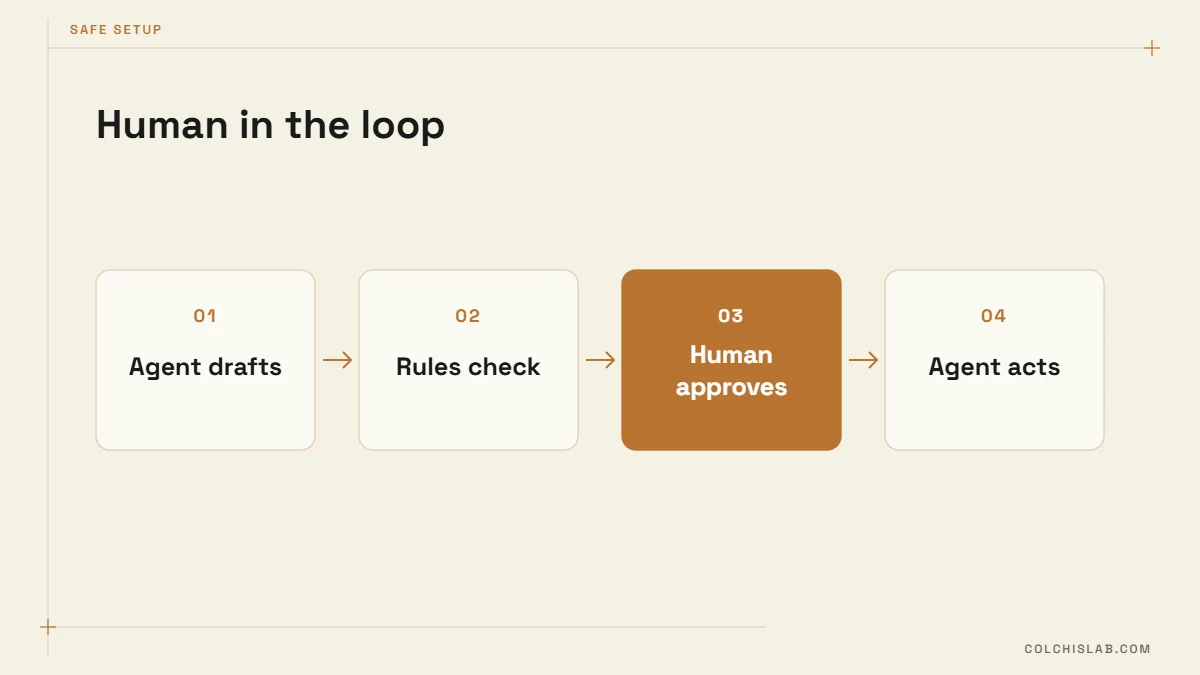
The safest pattern is graded autonomy. Start with the agent drafting and a person approving. When accuracy is consistently high for a task, let the agent act on its own for that task only, and keep approvals for anything involving money, commitments or sensitive data.
- Define what the agent may do alone, what needs approval and what it must hand over.
- Give it a clear handover phrase and route those chats to a named person with a notification.
- Log every action in the CRM so you can audit what happened.
- Review a sample of conversations weekly and update the knowledge base.
Remember data protection: customers should know they are talking to an AI, and personal data should only be used for the purpose it was collected for.
What AI Agents for Small Business Cost
Running costs are usually lower than owners expect; the real cost is setup and maintenance.
| Cost item | Typical range | Notes |
|---|---|---|
| AI model usage | From $0.10 to $10 per 1M input tokens | Depends on the model; see OpenAI API pricing |
| Workflow platform | n8n Cloud from €20/month (2,500 executions) | Or self-hosted on your own server; n8n pricing |
| Messaging channels | Varies | WhatsApp Business Platform charges per template message |
| Setup and integration | One-off project | Prompts, knowledge base, CRM and channel connections, testing |
A quick calculation: 1,000 customer conversations a month at about 4,000 tokens each is 4 million tokens. On a mid-priced model at $1–$5 per million tokens, that is roughly $4–$20 a month in AI usage. If the agent saves a staff member ten hours a month, it pays for itself many times over; the bigger investment is building it well.
Rolling Out AI Agents for Small Business in 30 Days
Pick one task from the list with high volume and low risk — usually inbox replies or lead qualification. Week 1: write down the rules, prices and the questions customers actually ask. Week 2: build the agent with draft-only mode. Week 3: run it alongside your team and correct it. Week 4: switch on autonomy for the safe parts and measure response time and conversions. Then add the next task. A good AI chatbot for your website is often the easiest first step.
Our automation and AI agent service designs and builds AI agents for small business owners around the tools you already use. Send us your project with the task you want to hand off, and we will tell you honestly whether an agent, a simple automation or neither is the right fit.
What is an AI agent for a small business?
It is an AI system that completes a defined goal, such as qualifying a lead or booking an appointment, by using your tools like the CRM, calendar and inbox. It acts, not just answers questions.
What is the difference between an AI agent and a chatbot?
A chatbot mainly answers questions in a conversation. An AI agent can plan steps and take actions, such as updating records, booking slots or sending follow-ups.
How much does an AI agent cost for a small business?
Running costs are often small: AI model usage for a thousand conversations can cost a few dollars to a few tens of dollars a month. Setup, integration and maintenance are the main costs.
Are AI agents safe to use with customers?
Yes, if you limit what they can do alone, keep a human approval step for money and commitments, and hand over complaints and sensitive cases to a person.
Can an AI agent replace an employee?
Usually not. It takes over repetitive parts of a role, such as answering common questions or entering data, so staff can focus on sales, service and exceptions.
Which task should I automate with an AI agent first?
Choose a task with high volume and low risk, such as answering price and availability questions or qualifying incoming leads. Start in draft mode and expand once accuracy is proven.