Table of Contents
AI Chatbot for Your Website: What It Can and Can’t Do in 2026
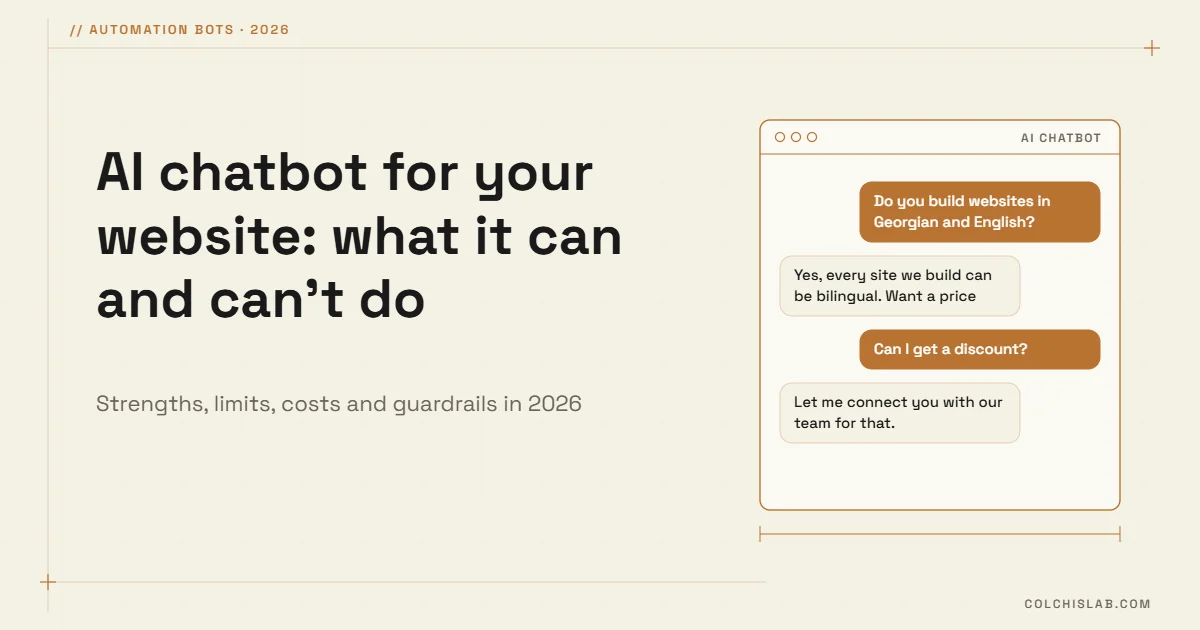
An AI chatbot for website visitors can answer questions in seconds, qualify leads and book appointments at any hour, but only if it is grounded in your own content and knows when to hand over to a person. Left unchecked, the same technology invents policies, promises discounts and creates legal risk. Here is an honest look at what an AI chatbot does well in 2026, where it fails, what it costs and the guardrails that make it safe.
What an AI chatbot for website visitors does well
Table of Contents
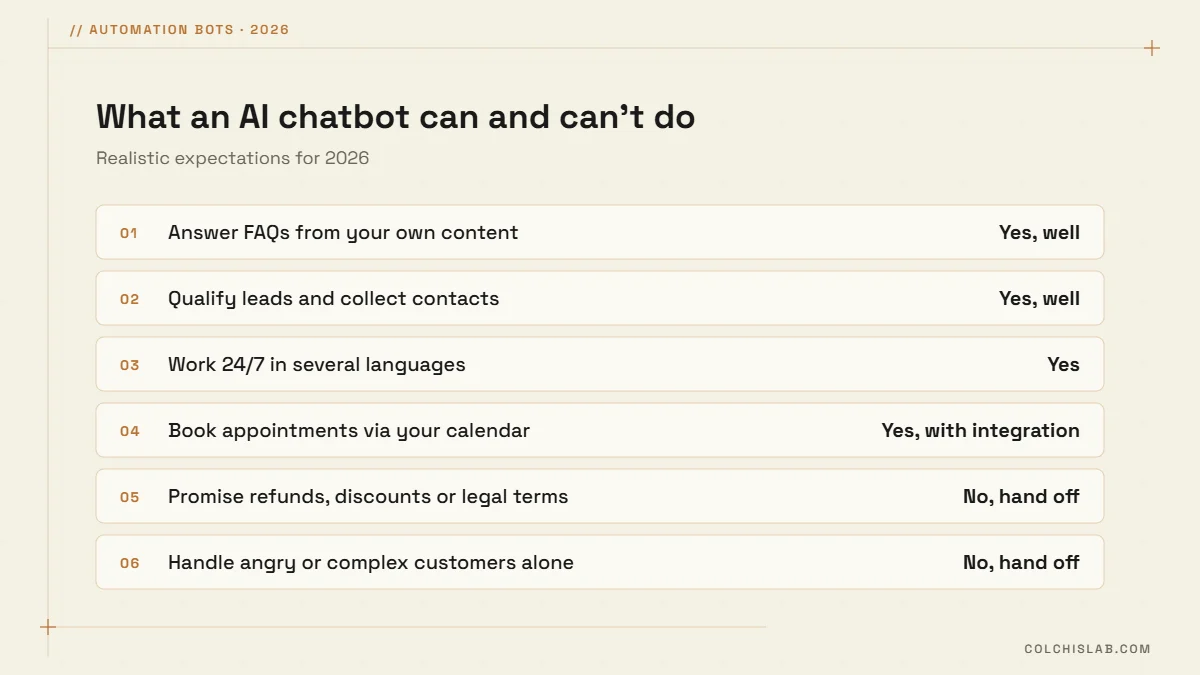
Modern language models understand questions written in everyday words, in many languages, and can answer from your pages, price lists and FAQs. That makes them good at the repetitive front line of customer contact:
- Instant answers about services, prices, delivery, opening hours and policies, 24/7.
- Lead qualification: asking budget, timeline and needs, then saving the contact to your CRM.
- Bookings through your calendar, with confirmation by email, WhatsApp or Telegram.
- Multilingual support in Georgian, English and Russian from the same knowledge base.
- Routing: recognising sales, support or complaint and sending each to the right person.
Where AI chatbots go wrong
Language models can produce confident answers that are simply false. Two well-known cases show what that costs:
- Air Canada (2024). The airline’s website chatbot told a customer he could claim a bereavement discount after travelling. That was wrong. A Canadian tribunal ruled the company responsible for what its chatbot said and ordered it to pay the difference (Moffatt v. Air Canada).
- Cursor (2025). The software company’s AI support agent invented a “one device per subscription” policy, and users cancelled subscriptions before the company corrected it publicly.
The lesson: your business owns every answer the bot gives. Customers also have mixed feelings. In a 2024 Gartner survey, 64% of customers said they would prefer companies not to use AI in customer service, mostly because they fear it will be harder to reach a person.
How a grounded AI chatbot works
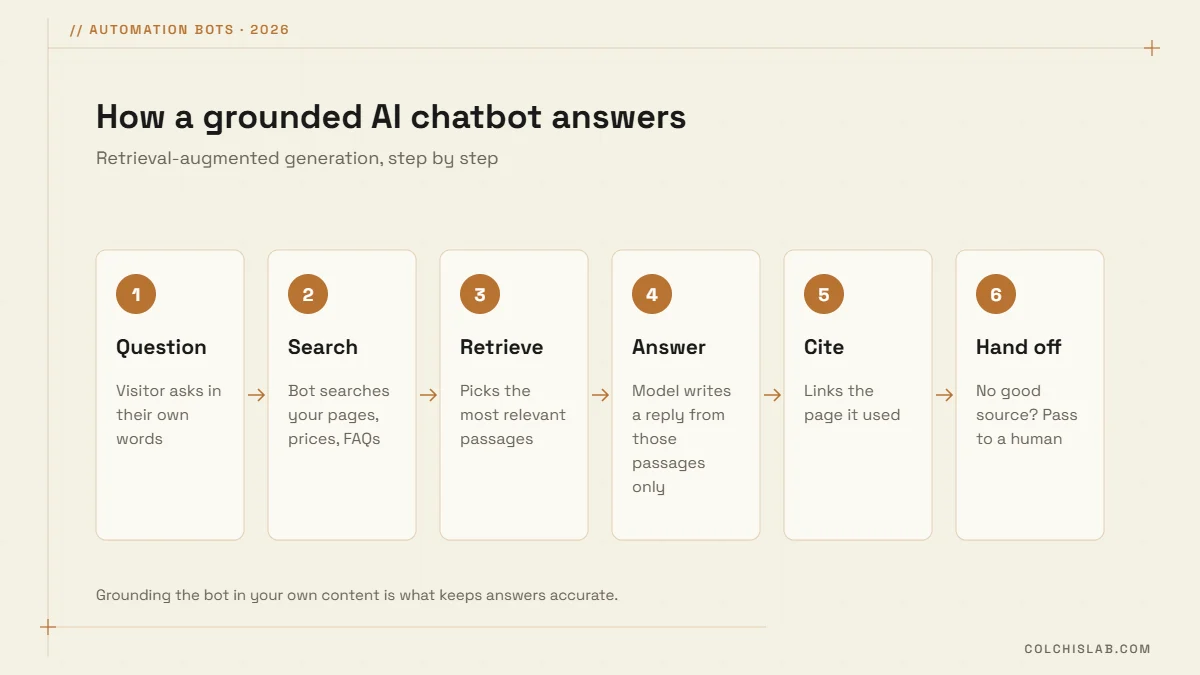
The fix for invented answers is grounding, usually called retrieval-augmented generation (RAG). Instead of answering from general knowledge, the bot first searches your own content, then writes its reply only from what it found, and admits when it does not know.
6 guardrails for a safe AI chatbot
- Say it is AI. Under Article 50 of the EU AI Act, applicable since 2 August 2026, people must be told when they are talking to an AI system, unless it is obvious. Fines for breaching these transparency duties can reach €15 million or 3% of worldwide turnover. It is also simply good practice.
- Answer only from approved sources and link the page used.
- Never let it decide money or law: refunds, discounts, contracts and medical or legal advice go to a person.
- Make the human route obvious: a “talk to a person” button on every reply.
- Protect data: do not ask for sensitive data in chat, and mention the bot in your privacy policy.
- Review conversations weekly and update the knowledge base with every wrong or missing answer.
What an AI chatbot costs
There are two routes. SaaS chatbot builders charge a monthly plan, from roughly $30 to several hundred dollars, or per resolved conversation; Intercom’s Fin, for example, is priced at $0.99 per resolution. A custom AI chatbot for website use pays the AI provider per token, which for a small business is typically a few dollars to a few tens of dollars per 1,000 conversations depending on the model, plus a one-time build.
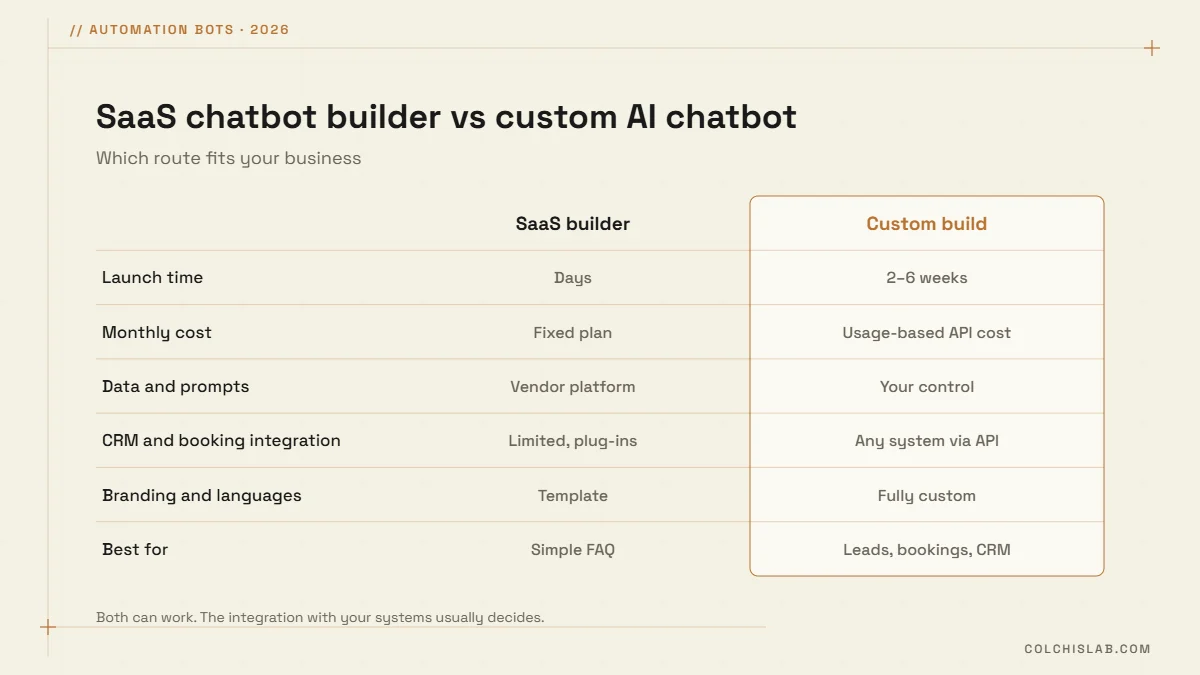
Choose a SaaS builder for a simple FAQ bot. Choose a custom build when the bot must create CRM leads, book into your calendar, follow your exact rules and live on your website, Telegram and WhatsApp at once, like the bots in our WhatsApp Business API guide.
Is an AI chatbot right for your business?
It is worth it when you receive many similar questions, leads arrive outside working hours, and your information is written down clearly enough for a bot to learn from it. It is not worth it if your website content is thin or outdated: fix that first, because the bot can only be as good as its sources.
We build AI chatbots grounded in your own content, connected to your CRM and with a clear handoff to your team. See our automation bots service, or send us your most common customer questions and we will show you how the bot would answer them.
What can an AI chatbot on a website do?
It can answer questions from your own content, qualify leads, collect contacts, book appointments, answer in several languages and route conversations to the right person, 24 hours a day.
Can an AI chatbot give wrong answers?
Yes. Language models can invent information. Grounding the bot in your own content, limiting it to approved sources and handing off unclear cases to a person greatly reduces the risk.
Is my business responsible for what its chatbot says?
In practice, yes. In Moffatt v. Air Canada a tribunal held the company responsible for its chatbot’s wrong advice. Treat bot answers like any other statement on your website.
Do I have to tell visitors they are talking to AI?
In the EU, the AI Act requires it from 2 August 2026, unless it is obvious. Even where it is not required, disclosure builds trust and is good practice.
How much does an AI chatbot for a website cost?
SaaS builders cost from about $30 to several hundred dollars a month, or a fee per resolved conversation. Custom bots pay per token, often a few dollars to tens of dollars per 1,000 conversations, plus a one-time build.
Can the chatbot work on WhatsApp and Telegram too?
Yes. A custom AI chatbot can use one knowledge base for your website, WhatsApp and Telegram, and send every lead to the same CRM.