Table of Contents
Landing Page vs Website: Which Does Your Business Need?
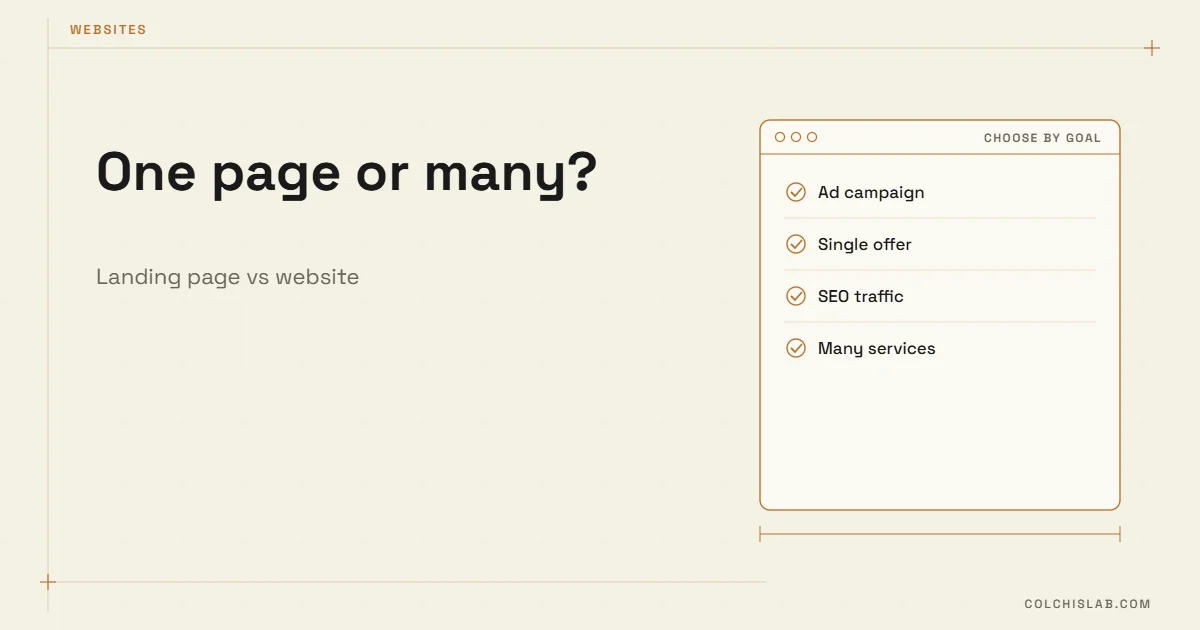
The landing page vs website choice comes down to one question: do you need to sell one offer to one audience right now, or explain your whole business and be found on Google over time? A landing page is a single focused page with one goal, usually fed by ads. A website is a set of pages that covers all your services, builds trust and earns search traffic.
Most small businesses eventually need both, but the order matters. Below we define each, compare them side by side, show when each one wins, and outline the hybrid setup we build most often at Colchis Lab.
Table of Contents
What a Landing Page Is (and Is Not)
A landing page is a standalone page built for one action: book a call, request a quote, download a guide, buy one product. It usually has no main navigation, because every extra link is a way out. The structure is predictable: a headline that matches the ad, the offer and its benefits, proof (reviews, logos, numbers), answers to objections, and one repeated call to action.
It is not just “a short website”. A one-page site that lists all your services with a menu is a brochure, not a landing page. The difference is focus: a landing page is written for one visitor with one intent. Our guide to the anatomy of high-converting landing pages covers the design side in detail.
What a Website Does That a Landing Page Can’t
A business website is your permanent home online. It describes every service, introduces the team, publishes prices or case studies, answers questions in a blog, and gives Google many relevant pages to rank. Visitors arrive with different intents — some compare, some check your address, some are ready to buy — and the navigation lets each find their path.
That breadth is what makes organic search possible. One page can rank for a handful of closely related queries; a site with a page per service, location and common question can rank for hundreds. If SEO is part of your plan, read SEO for small business before you decide.
Landing Page vs Website: Side-by-Side Comparison
| Criterion | Landing page | Website |
|---|---|---|
| Goal | One conversion action | Inform, build trust, convert many intents |
| Pages | 1 (sometimes 2–3 variants) | 5–50+ |
| Navigation | None or minimal | Full menu, footer, internal links |
| Main traffic | Paid ads, email, social campaigns | Organic search, direct, referrals |
| SEO potential | Low — one topic | High — many pages and topics |
| Typical build time | Days to 2 weeks | 3–8 weeks |
| Lifespan | Weeks to months per campaign | Years, with updates |
| Best metric | Conversion rate, cost per lead | Organic traffic, leads per month |
Neither column is “better”. The landing page vs website comparison is really a comparison of jobs: short-term conversion versus long-term presence.
When a Landing Page Wins
Choose a landing page first when the traffic is paid and the offer is narrow. Google Ads rates every keyword’s landing page experience on whether the page is relevant, clear and useful for the search; a page written for exactly that search tends to score better than a generic homepage, and that feeds into Quality Score and what you pay per click.
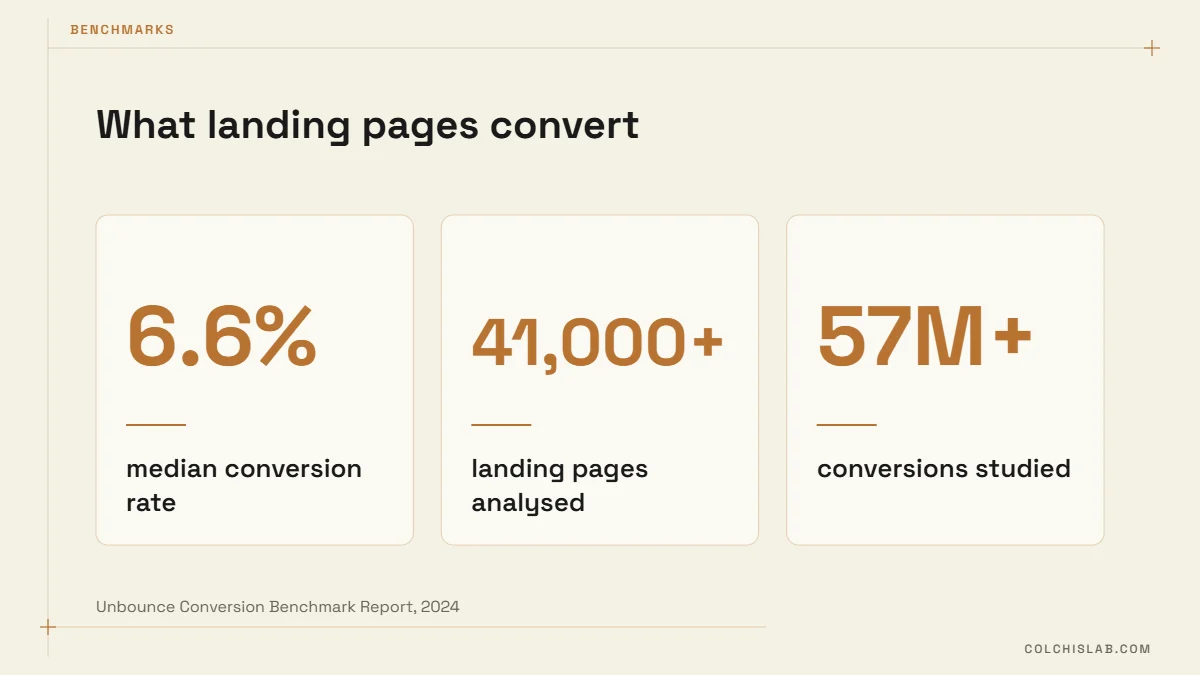
Focus also pays off in conversions. The Unbounce Conversion Benchmark Report (2024) analysed more than 41,000 landing pages and 57 million conversions and found a median conversion rate of 6.6% across industries. Medians vary a lot by sector, so treat that as a reference point, not a target.
- A launch or promotion with a deadline, such as a seasonal offer or a new clinic opening.
- Testing demand for a new service before investing in a full site.
- One product or lead magnet — a course, an event, a free audit.
- Separate ad audiences that need different messages, for example homeowners versus developers.
Mini-calculation: if you spend $1,000 a month on ads at $1 per click, 1,000 visitors land on your page. At 2% conversion that is 20 leads at $50 each; at 6% it is 60 leads at about $17 each. The same budget, three times the leads — that is why focus matters.
When a Website Wins
Choose a full website first when people will look you up before buying, when you sell several services, or when you want traffic you do not pay for per click. Trust-heavy businesses — clinics, real estate agencies, B2B services, hotels — almost always need the depth of a website, because buyers check the team, the address, reviews and prices before they call.
- You offer three or more distinct services or audiences.
- You plan to invest in SEO, content or AI search visibility.
- Customers find you by brand name and expect a professional presence.
- You need e-commerce, booking, multiple languages or a client area.
A website also gives your ads somewhere credible to send people who are not ready to convert yet. If you are unsure which platform to use, compare WordPress vs Wix vs Shopify.
Five Questions That Settle Landing Page vs Website
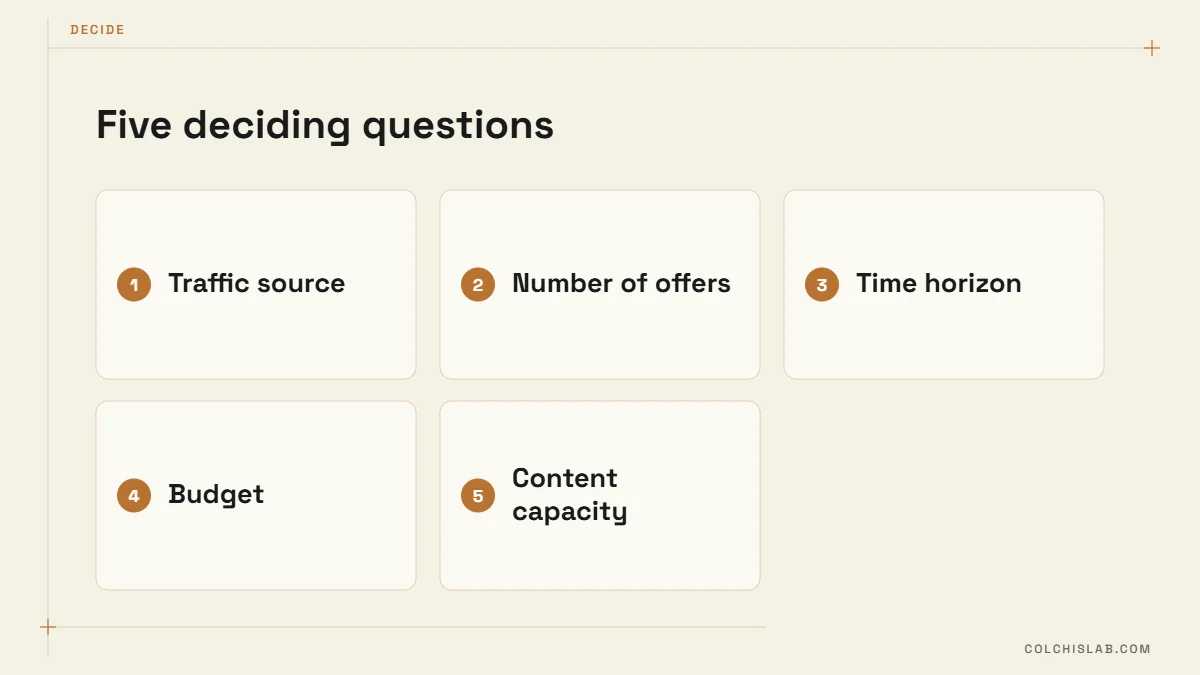
- Where will the traffic come from? Mostly paid ads → landing page. Mostly Google search → website.
- How many offers do you sell? One → landing page. Several → website, with a landing page per campaign later.
- How long is your horizon? Results this month → landing page. Steady leads in 6–12 months → website plus SEO.
- What can you spend now? A tight budget usually means a strong landing page first and a site in phase two.
- Can you produce content? A website without service pages and updates underperforms; if nobody will write, keep it small.
If three or more answers point the same way, your landing page vs website decision is made.
Example: a Tbilisi renovation company with a ₾3,000 monthly ad budget and one hero service (turnkey apartment renovation) should start with a landing page. A law firm with six practice areas and clients who search “lawyer for X” should start with a website. A mistake we see often in landing page vs website debates is building a 30-page site for a business that only runs ads, then wondering why the leads are expensive.
Another common mistake is the opposite: sending all paid traffic to a homepage built for everyone. When the landing page vs website roles are mixed up, both underperform — the ads lose relevance and the site fills with campaign pages that compete with your service pages in search.
Cost and Time: What to Expect
A landing page is one design and one set of copy, so it typically takes days to two weeks and costs a fraction of a full site. The real cost is the copywriting, tracking setup and the iterations after launch. A website needs information architecture, several templates, more content and technical SEO, so it usually takes three to eight weeks. Our website cost guide for 2026 breaks down the numbers, and our prices page lists current packages.
Two hidden costs often swing the landing page vs website budget: ad spend (a landing page with no traffic produces nothing) and content (a website with thin pages will not rank). Budget for traffic or content, not just the build.
The Hybrid Approach We Recommend
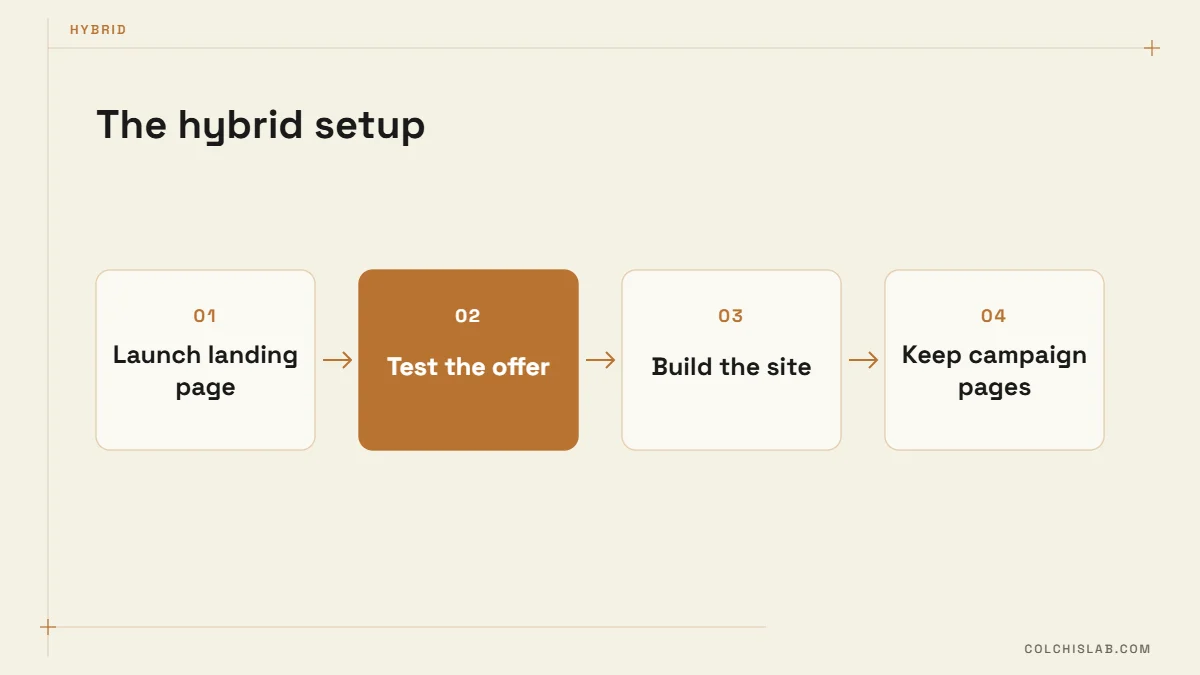
For most small businesses we build in stages. Launch a focused landing page, connect its form to your CRM so no lead is lost (see connecting a website form to a CRM), run ads for four to eight weeks and learn which message converts. Then build the full website using that proven message on the homepage and service pages. Keep separate landing pages for each future campaign and exclude them from search with noindex if they duplicate service pages.
This way the landing page vs website question stops being either/or: the landing page earns money and data now, the website compounds over time. Google’s own helpful content guidance rewards pages written for people, which is exactly what a tested message gives you.
Our web development team builds both, on fast WordPress setups with tracking from day one. Send us your project — tell us your offer, budget and traffic plans, and we will recommend landing page, website or both, in that order.
What is the difference between a landing page and a website?
In the landing page vs website comparison, a landing page is a single page built for one action, usually from an ad or campaign, with no navigation. A website has many pages that describe your whole business, support different visitor intents and can rank in search.
Is a landing page enough for a small business?
It can be enough for one offer promoted with ads, or to test demand. Once you sell several services or want organic search traffic, you will need a website as well.
Can a landing page rank on Google?
Yes, for a small set of closely related queries if it has useful content and some links. But one page cannot compete with a website that has a page for every service and question.
Should I send Google Ads traffic to my homepage or a landing page?
Usually a landing page. Google Ads rates landing page experience by how relevant and useful the page is for the search, and a dedicated page also tends to convert better than a general homepage.
What is a good landing page conversion rate?
Unbounce’s 2024 benchmark of more than 41,000 pages found a median of 6.6% across industries. Rates vary widely by sector and offer, so compare against your own past results first.
Landing page vs website: which should I build first?
If you need leads quickly from ads, start with a landing page. If you depend on search or sell many services, start with the website. Many businesses launch a landing page first and build the site with what they learn.