Table of Contents
Mastering Core Web Vitals: How Performance Impacts Conversion Rates

In modern web development, speed is no longer just a technical metric—it is a core pillar of user experience and revenue generation. When a potential customer clicks on your website, every hundred milliseconds of delay increases friction, damages brand credibility, and drives bounce rates higher.
Google’s Core Web Vitals framework quantifies page performance around real-world user metrics: loading performance, interactivity, and visual stability. Understanding and optimizing these key performance signals is essential to securing top organic search rankings while maximizing revenue conversion rates.
01 — The High Cost of Slow Page Performance
Sluggish loading speeds and unstable user interfaces actively erode revenue potential across all acquisition channels.
- High Bounce Rates: Over 50% of mobile users abandon a website if page loading exceeds three seconds.
- Organic Search Penalties: Search engine algorithms explicitly deprioritize slow, frustrating web pages in competitive search result rankings.
- Lower Ad ROI: Paid traffic campaigns suffer from higher cost-per-acquisition (CPA) when landing pages fail to load instantaneously.
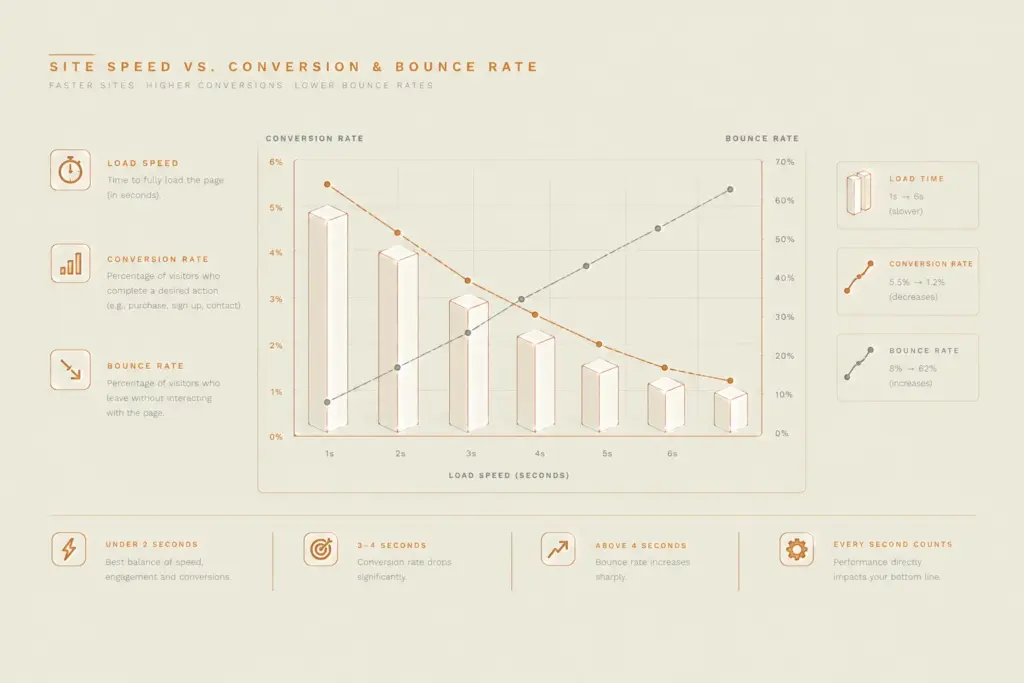
“Page speed is the ultimate multiplier for digital marketing. An incredible user experience means nothing if visitors bounce before the page renders.”
02 — Decoding the Three Core Web Vitals Metrics
Achieving green scores across Google’s performance standards requires targeted optimization across three primary user-centric metrics.
1. Largest Contentful Paint (LCP) — Loading Speed
LCP measures how long it takes for the largest visual element (hero image, banner, or main headline) to render on screen. Target LCP execution within 2.5 seconds using image compression, CDN edge delivery, and critical CSS inline rendering.
2. Interaction to Next Paint (INP) — Responsiveness
INP measures page responsiveness by tracking latency across all user interactions (clicks, taps, and key presses). Keep INP below 200 milliseconds by minimizing heavy JavaScript execution and deferring non-essential scripts.
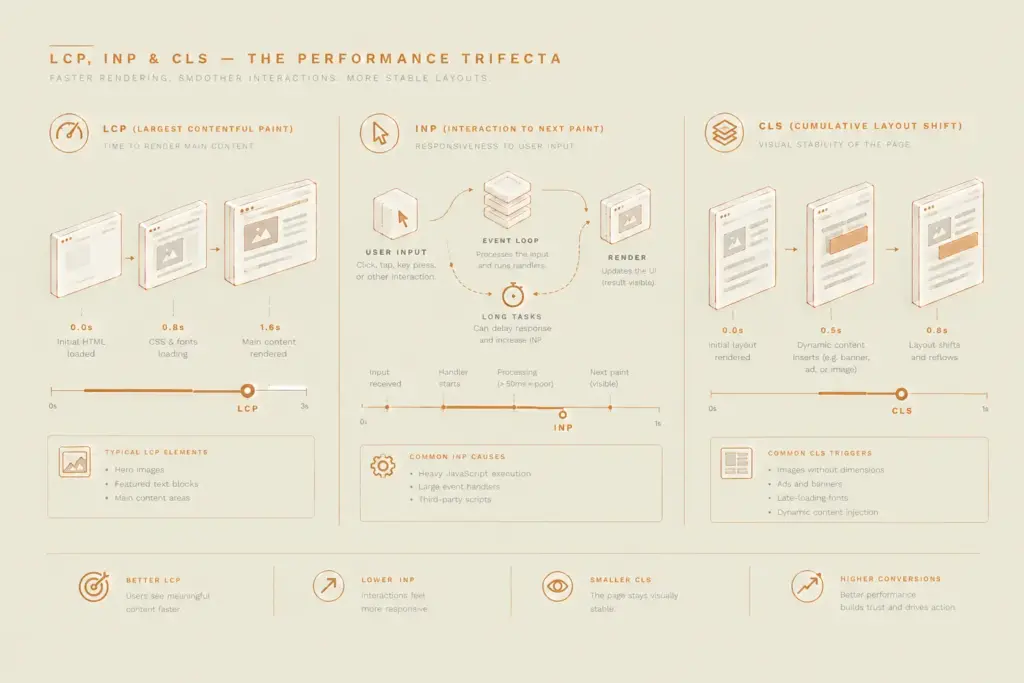
3. Cumulative Layout Shift (CLS) — Visual Stability
CLS evaluates unexpected layout shifts during page loading. Maintain a CLS score under 0.1 by setting explicit image height/width attributes and reserving space for dynamic web fonts or banners.
03 — Strategic Benefits of Performance Optimization
Investing in dedicated web performance engineering delivers immediate measurable returns across SEO and sales pipelines:
- Boosted Conversion Rates: Seamless, instant interactions keep visitors engaged throughout purchasing and lead generation forms.
- Superior Mobile User Experience: Fast loading times ensure frictionless navigation across variable mobile networks.
- Higher Search Engine Authority: Passing Core Web Vitals benchmarks gives your site a competitive edge in organic ranking positions.
04 — Building Infrastructure for Speed & Scale
Optimizing Core Web Vitals transforms technical performance into a long-term commercial advantage. By engineering fast, responsive, and visually stable web foundations, your platform delivers an outstanding user experience that converts traffic into sustainable growth.
Accelerate Your Web Performance & Drive Higher Conversions
Don’t let slow loading speeds drain your search traffic and conversion pipeline. Explore our specialized SEO Optimization Services and check our transparent Development & SEO Pricing to start optimizing your Core Web Vitals today.