Table of Contents
Designing Conversational UX: How AI Bots Drive Support Efficiency
Customer support expectations have shifted dramatically. Modern users expect instant, accurate answers 24/7 without waiting in ticket queues or navigating confusing phone menus. However, scaling human support teams to meet this demand often leads to ballooning operational costs and inconsistent service quality.
This is where conversational UX and intelligent AI automation bridge the gap. By combining natural language understanding with well-architected user flows, AI bots can handle routine inquiries instantly, allowing human agents to focus on high-value, complex customer interactions.
01 — The Downside of Traditional Support Systems
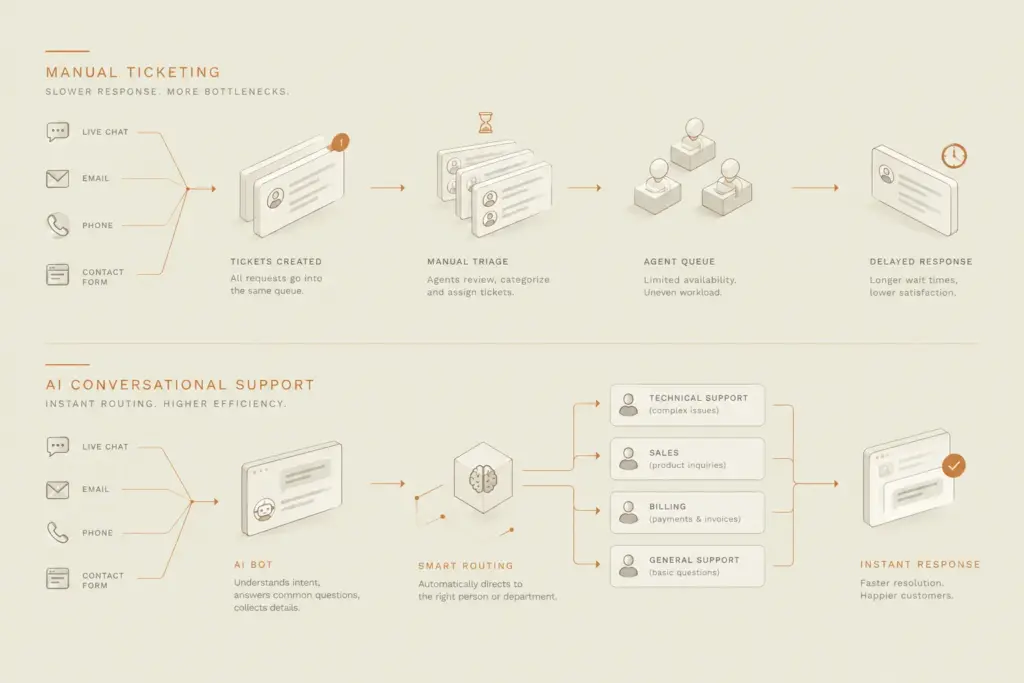
Legacy support channels—such as static contact forms, basic rule-based chatbots, and manual email ticketing—often frustrate users and slow down internal operations.
- High Ticket Latency: Customers wait hours or days for answers to simple, repetitive questions (e.g., order tracking, reset links, business hours).
- Frustrating Rule-Based Chatbots: Rigid decision-tree bots that fail to understand natural phrasing alienate users, forcing them to demand a human representative immediately.
- Agent Burnout from Repetitive Tasks: Human support staff spend up to 60% of their time answering recurring questions rather than solving nuanced user problems.
“Great conversational UX doesn’t feel like talking to a wall of code. It understands intent, provides immediate context, and seamlessly hands off when human expertise is required.”
02 — Pillars of High-Converting Conversational UX
Designing an effective AI bot requires more than just connecting a language model; it requires a structured UX framework designed for clarity and speed.
1. Intent Recognition & Context Awareness
Rather than forcing users into rigid button options, modern conversational systems analyze user intent, sentiment, and account history to deliver personalized, relevant answers instantly.
2. Micro-Interactions & Rich UI Components
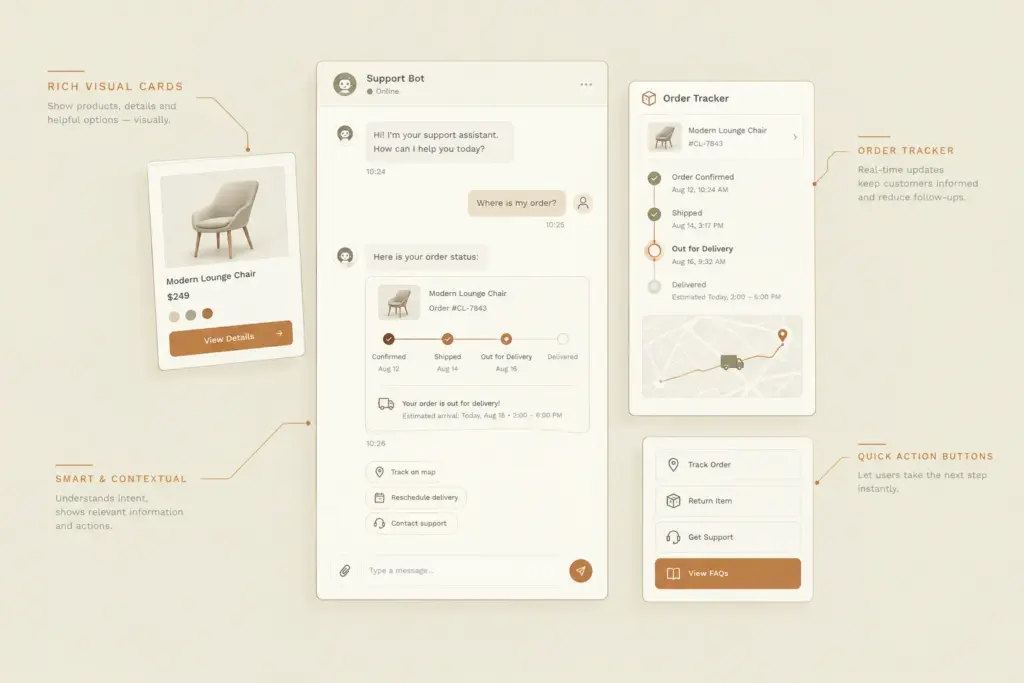
Conversational UX extends beyond plain text messages. Integrating rich visual cards, interactive date pickers, fast-reply chips, and inline order summaries inside the chat window keeps interactions intuitive and efficient.
3. Frictionless Escalation to Human Agents
When a query exceeds the bot’s capabilities, the conversation must transfer gracefully to a live support representative, passing along full transcript history and context so the customer never has to repeat themselves.
03 — Operational Benefits of Automated Support Bots
Integrating conversational AI into your business operations delivers measurable improvements across key efficiency metrics.
- Up to 80% First-Contact Resolution (FCR): Automated resolution of routine tasks drastically reduces incoming ticket volumes for core support queues.
- 24/7 Global Availability: Provide instant response times around the clock without increasing night-shift staffing costs.
- Automated CRM & Helpdesk Sync: AI bots automatically log interaction notes, tag ticket categories, and update customer profiles in systems like Zendesk or HubSpot without manual data entry.
04 — Building an Intelligent Automation Strategy
Deploying conversational AI is not about replacing human support—it is about scaling your team’s reach and improving customer satisfaction. By investing in clean conversational UX, robust system integrations, and clear escalation protocols, your organization can build a support engine that drives long-term efficiency and brand loyalty.
Outdated support systems slow down operations and frustrate users. We build custom conversational UX and automation workflows that resolve routine inquiries instantly while reducing operational costs.
Explore our full range of solutions on our Services Page or discover how we build smart systems on our Automation & AI Bots Page.