Table of Contents
Structuring CRM Architecture for Maximum Sales Efficiency

A Customer Relationship Management (CRM) platform is meant to be the central growth engine of an enterprise. However, many sales organizations treat their CRM as little more than a glorified digital address book. Misaligned deal stages, bloated custom fields, missing mandatory properties, and unstructured pipelines create operational noise that actively hampers sales reps instead of helping them close deals.
Building a high-converting sales engine requires designing your CRM architecture around real buyer behavior and precise operational hand-offs. When structured correctly, your CRM enforces process discipline, provides clear pipeline visibility, and accelerates revenue growth across every deal stage.
01 — Common Structural Pitfalls in CRM Design
When CRM platforms are implemented without a clear architectural blueprint, they quickly turn into cluttered, inefficient databases that sales teams avoid using.
- Ambiguous Deal Stages: Defining stages by sales actions (e.g., “Sent Email”) rather than verifiable prospect commitments (e.g., “Discovery Completed”) creates inaccurate forecasting.
- Over-Engineering Custom Fields: Forcing sales reps to fill out dozens of non-essential fields during early deal stages causes data fatigue and incomplete records.
- Lack of Standardized Data Entry Rules: Without enforced required fields and dropdown validation, database records become duplicate-ridden and impossible to segment accurately.
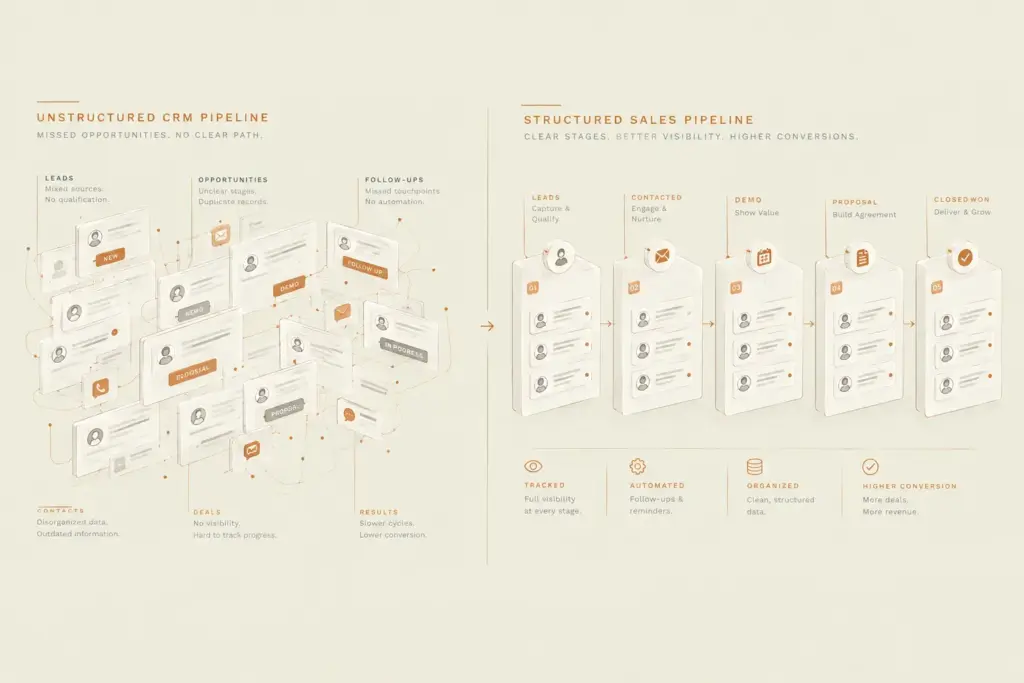
“A CRM shouldn’t record what your sales reps think happened—it should structurally mirror where the prospect actually sits in their buying journey.”
02 — Blueprint of an Efficient CRM Architecture
Structuring a CRM for maximum velocity requires establishing clear stage-gating, standardized data properties, and automated operational hand-offs.
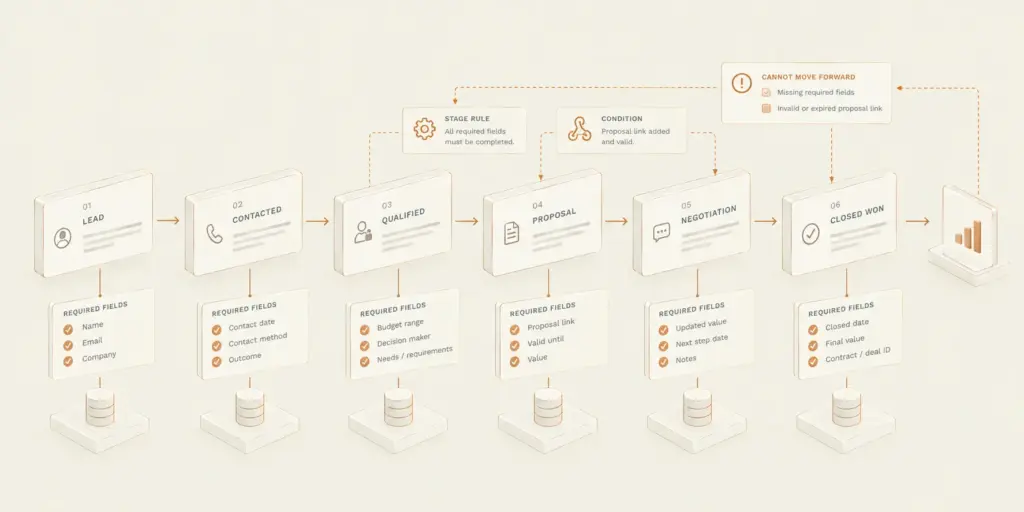
1. Objective, Milestone-Driven Deal Stages
Every stage transition in your pipeline must require a specific, verifiable buyer action—such as completing a discovery call, confirming budget alignment, or reviewing a technical proposal.
2. Stage-Gated Required Fields
Enforce data hygiene by requiring sales reps to input key decision parameters (e.g., decision-maker role, timeline, primary pain point) before a deal can advance to the next pipeline stage.
3. Automated Ownership and Pipeline Routing
Eliminate manual hand-off delays by routing newly qualified leads instantly to the right account executives based on deal size, territory, or technical requirements.
03 — Quantifiable Benefits of Optimized CRM Structure
Re-architecting your CRM to reflect clean operational workflows yields immediate performance returns across your sales team:
- Accurate Revenue Forecasting: Clear stage definitions remove guesswork, providing leadership with real-time, reliable pipeline projections.
- Reduced Administrative Friction: Reps spend less time navigating bloated forms and more time engaging directly with high-intent decision-makers.
- Shorter Sales Cycles: Enforced criteria at every stage prevent unqualified deals from lingering in your active pipeline.
04 — Building a Scalable CRM Foundation
Your CRM is the backbone of your commercial operations. By structuring pipelines around clear buying milestones, enforcing clean data hygiene, and removing administrative friction, your organization creates a repeatable sales engine built for long-term scalability.
Optimize Your Sales Engine for Maximum Velocity
Stop letting valuable deals stall in an unstructured pipeline. Explore our CRM integration services and discover how our tailored digital solutions can streamline your sales architecture, enforce data discipline, and accelerate revenue growth.